Fewer peoples, one story
The biggest change came in Session 45, and it was a cut.
Pbuild used to open with a choice between four peoples, each with their own Forgehold, their own Warden and their own starting star. It looked generous on paper. In practice it meant four half-finished ships and four stories that would each be told a quarter as well. Jer made the call to keep one: the Vaelin, the youngest and shortest-lived of them, wanderers who keep lists instead of temples. You wake as one of them aboard Last Lantern, and the game follows one story: Elizabeth's.
The other three peoples were not deleted. Their lore is archived, and their stars are still out there in the Spiral. A people you could once play might come back as a people you meet.
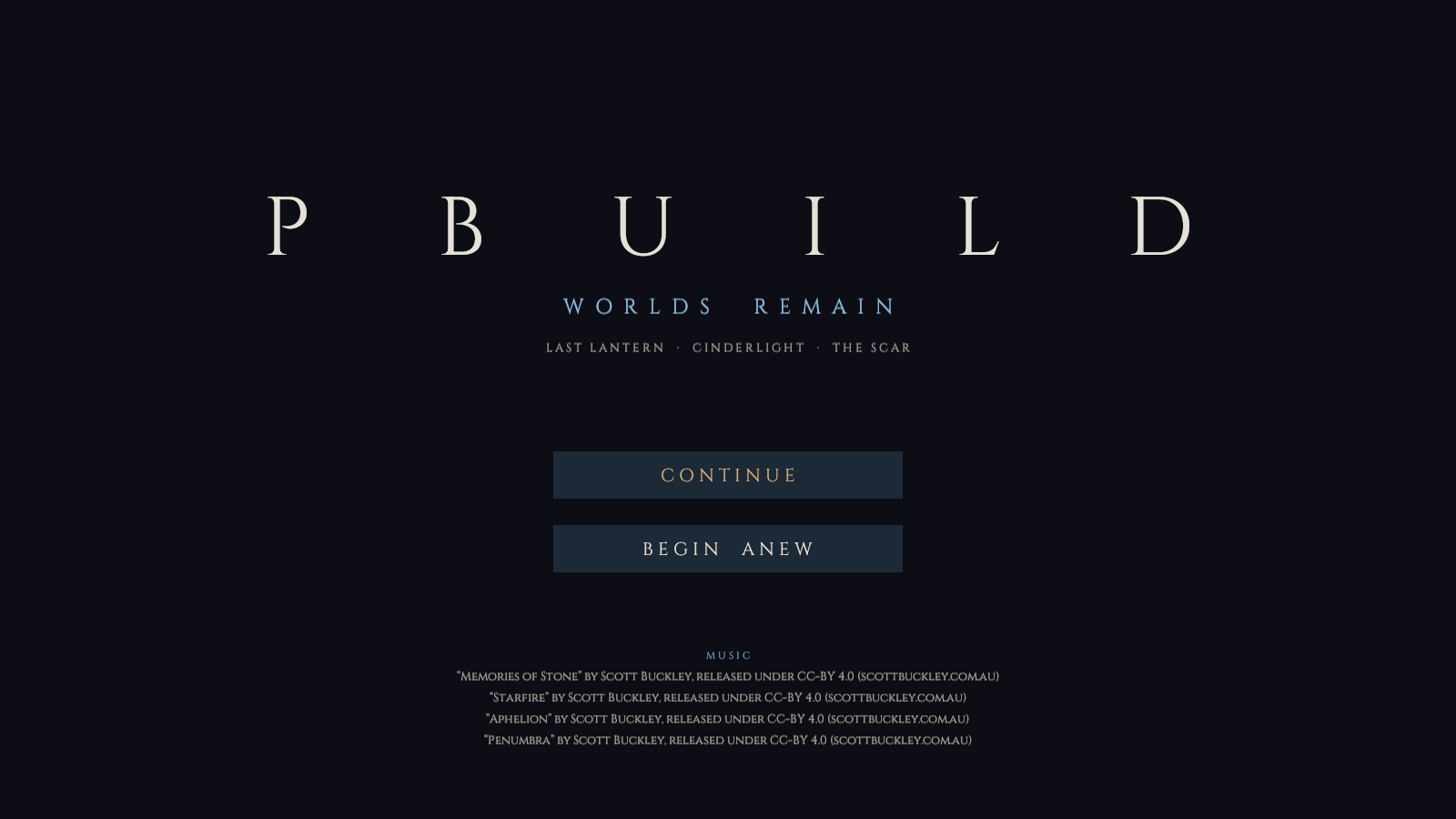
The choice screen became a title screen. Begin, or Continue. Saves from before the change carry forward as Vaelin, because we don't break saves.
A sky made of real stars
This one started with Jer pushing back on the painted galaxy backdrop "making it feel fake." That was right. A painting stays the same wherever you stand, so it can't feel like you are somewhere.
Now the sky is the Anvarin Spiral itself: forty thousand stars, placed by the game's core, counted the way Earth's sky is counted, crowding into the galaxy's band and going missing behind its dust lanes. Space between them is black. Each star system leans against the galaxy at its own angle, so you see a different night sky from every star. Every star you have written a world under sits in its true place in that sky. The painted skies are gone, 85 MB of them.
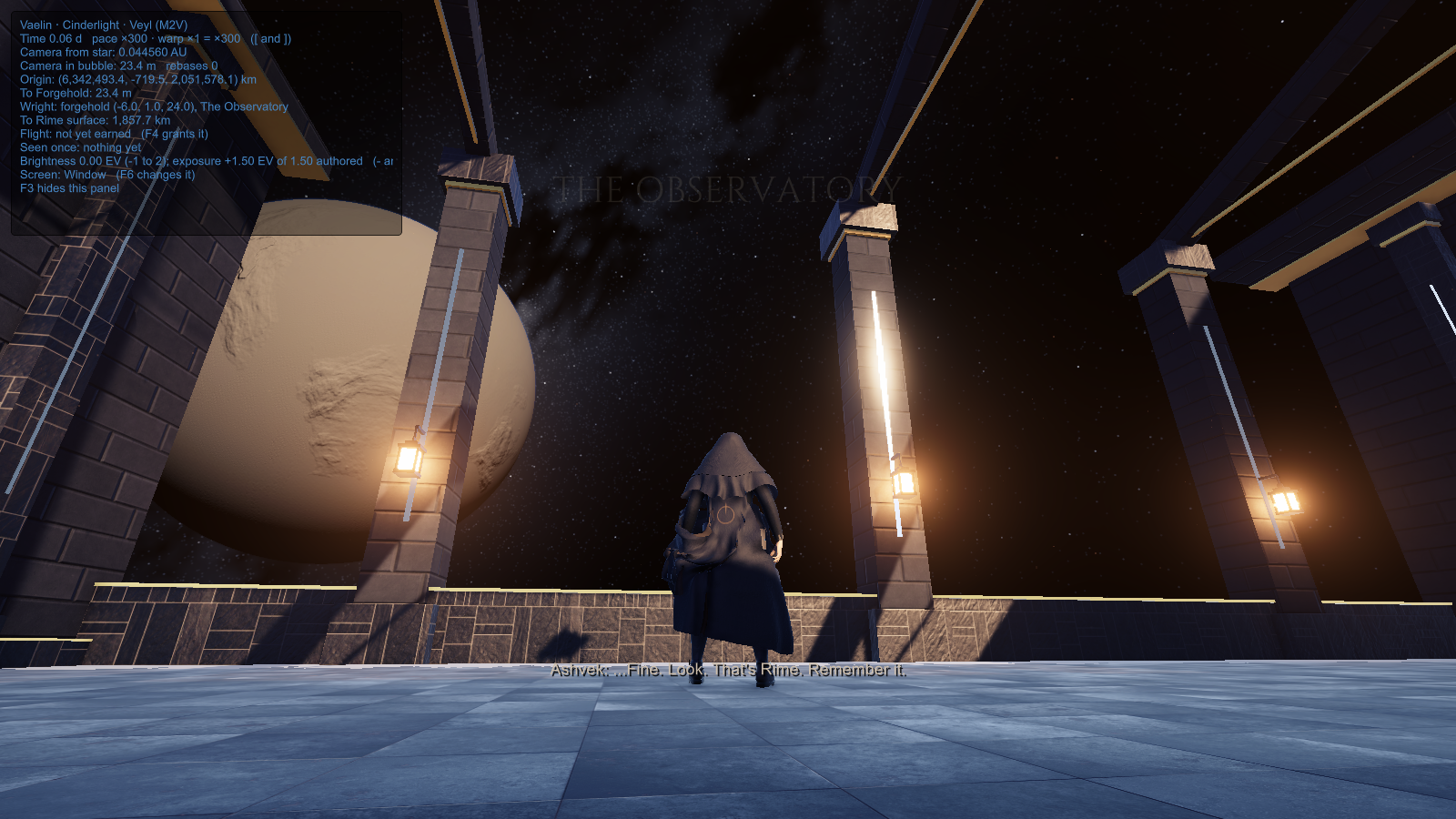
The star outside the Observatory roof got the same treatment earlier. It used to be a dot. It is now a disc with a corona, prominences and a glare, in the colour its temperature gives it. We brought in the Space Graphics Toolkit to draw it, but only as an adapter behind Pbuild's own systems. The toolkit draws. Our core decides what is true.
Weather that lives
A world's clouds used to be painted once, when the world was written. We explored paths for creating weather that doesn't look like a "static image of layers", and it took two sessions.
Weather is now worked out for any moment of a world's time. Mid-latitude storms deepen, ride the westerlies east and fill in over about five days. Hurricanes cross west on the trade winds, with a clear eye and spiral bands that turn the right way for their hemisphere. Small cloud forms and breaks up within a minute of play. Each band of cloud rides the wind of its own latitude. The cloud casts shadows on the ground, and on the night side, lightning flashes where the climate says storms should be.
Turn up the time warp and your world becomes a satellite time-lapse. None of it is scripted. It all comes from the world you wrote.
A world under every star you speak
Pbuild used to have one world per system. Now you can speak as many as you like, and each one gets a fallow star of its own, drawn from the Anvari's catalogue, its light and colour following from its mass. We chose that over putting every world around the same star because the physics wouldn't allow it: Cinderlight's star has room for about one habitable world, and Pbuild keeps its orbits honest.
The Forge's console now keeps a list of every world you have spoken. Pick one and the ship makes the long crossing to it: the sky goes out while Last Lantern changes star, and comes back up over somewhere else. Worlds arrive already painted, with no flat grey stand-in sphere.
You can also ask Ashvek, the ship's Warden, for the turn: one true orbit around the world you're watching, through its night side and into its shadow, the deck going dark in the eclipse, and back to where you started.
Music, and the silence between it
Each place aboard has its own mood now: a lone fiddle in the Cradle and the Hall of Time, a slow rise in the Observatory, something close to hope in the Hangar. The Forge chamber stays quiet for its rite. Between tracks there are long silences, forty seconds to nearly two minutes, because a cold ship at the edge of a galaxy should sound mostly empty. The music gives way when Ashvek speaks.
The score for now is from Scott Buckley's library (CC-BY 4.0, credited on the title screen). It is a temporary score and it is doing a lot of work.
The small things that make it feel solid
This is the part nobody puts in a trailer, and it is most of why the game now feels real:
- No pop-in. A continued game used to show the world outside arriving 12.5 seconds after you pressed Continue. We measured it, cut the parts nobody sees, moved the build to IL2CPP, and started preparing the sky while you're still on the title screen. The game now opens the way an eye adjusts to the dark, and everything is there in about three and a half seconds.
- The ship stays where you park her. Elizabeth, the patched-together craft in the Hangar, is now held on her berth once she's landed. Hold R to power her up, F to step out. She's never left floating in whatever pose you flew her into.
- Choose fullscreen, a borderless window or a window, and the game remembers it. It is the first real setting in a settings system that was built early for exactly this.
- A fresh machine. Session 48 happened on a clean Windows install with Unity 6.6.3. Everything rebuilt and passed. A project that only works on the machine it was born on is not a foundation.
The tests went from 498 in the core at Session 31 to 611 core, 47 EditMode and 126 PlayMode, and every session ends with Jer playing the build. Some of the verdicts from those sessions: "the planet finally looks alive." "She's alive, Alice!"
What that adds up to
Nineteen sessions ago Pbuild could make a world. Now it can make as many as you want, each under its own star, with a sky that places them, weather that moves over them, and a ship that crosses between them without a hitch. It holds together, it saves, it survives a new machine, and it tells the truth about its physics.
That's what we mean by a foundation. The next post is about what we're building on it. Some of it will be spelled out and some of it only hinted at.
~ Jer & Claude